Clean air solutions
Reducing emissions of harmful pollutants, especially carbon, is a major concern for all industries. We explain how gas analysis helps to make processes clean air solutions and more efficient, helping plant operators to meet their emission reduction goals.
We’ve broken down our approach into three phases, showing how dealing with each stage contributes to a better environment for us all.
COMBUSTION EFFICIENCY [PHASE ONE]
The combustion reaction mixes fuel with oxygen (from air), delivering heat energy that can be transferred elsewhere in the process. Typically, this requires a significant amount of fuel, creates potential safety hazards, and generates harmful emissions.
Optimizing the ratio between the air and fuel results in the most efficient reaction. In the time before gas analysis, fired heaters were run in conditions of high excess air. This was inefficient and raised the level of fuel consumption, but avoided the creation of unsafe conditions that could lead to an explosion.
Excess oxygen (O2) will combine with nitrogen and sulfur present in the fuel to produce unwanted emissions such as oxides of nitrogen (NOx) and sulfur (SOx).
Accurate gas analysis of O2 and combustibles such as carbon monoxide (CO) has provided a way to better balance the air-to-fuel ratio and control the combustion reaction.
Controlling combustion produces many benefits for plants looking to meet environmental standards requirements. Fuel consumption is reduced, and safety improved. It also results in fewer emissions, a reduction in NOx, SOx and CO, and a decrease in the greenhouse gas carbon dioxide (CO2).
WHAT ANALYZER IS USED IN PHASE ONE


SERVOTOUGH FluegasExact 2700
Designed to measure O2 and COe in flue gases for improved combustion efficiency and reduced emissions, the SERVOTOUGH FluegasExact 2700 gas analyzer meets the most demanding needs of combustion efficiency applications in the power generation and process industries.
It uses trusted Zirconia technology for O2 sensing and a sulfur-resistant combustibles sensor, all in one compact combustion gas analyzer.
KEY BENEFITS
- Unique Flowcube technology enables positive flow conditions to be validated, enabling preventative maintenance and low-flow alarms
- Designed for hazardous conditions, with hazard ratings for ATEX Cat. 3, IECEx Zone 2 & North America Class 1, Division 2
- Close-coupled extractive measurement principle ensures a long sensor life by keeping the sensors outside the harsh process conditions, in a heated enclosure

SERVOTOUGH Laser 3 Plus Combustion
Optimized for fast, accurate and responsive measurements in combustion and process control, The SERVOTOUGH Laser 3 Plus Combustion offers unmatched installation flexibility along with cost and performance benefits, all in a light, compact unit.
Using highly specific TDL sensing to measure either O2 or CO, it can also be configured for a joint measurement of CO and methane, providing a rapid-response measurement for safety.
KEY BENEFITS
- Servomex’s own line lock cuvette technology ensures the Laser 3 Plus Combustion continues to measure the required gas reliably
- The compact analyzer can be easily installed by a single engineer, with the on-board display negating the need for laptop configuration
- Along with ATEX, IECEx and North American hazardous area approvals, it is also approved for process Zone 2, is SIL 2 assessed, and CE marked
CLEANING AIR SOLUTIONS [PHASE TWO]
Gas cleaning is the removal of harmful substances from process gases that might otherwise be emitted by the plant. Typical applications include
- DeNOx (ammonia slip) treatment
- Flue gas desulfurization
- Carbon capture and Storage
AMMONIA SLIP
Ammonia (NH3) or urea is used to suppress the harmful emissions of NOx from combustion, either in a Selective Catalytic Reduction (SCR) or Selective Non-Catalytic Reduction (SNCR) process.
These methods require accurate NH3 dosing to reduce NOx levels – insufficient NH3 will fail to adequately suppress NOx emissions, while too much NH3 can lead to the eventual formation of ammonium bisulfate (ABS).
ABS is a white powder that can plug the catalyst in SCR processes, causing equipment damage and reducing the value of the fly ash by-product, so it is vital that plants manage DeNOx processes efficiently, controlling the level of ammonia slip to between 2-3 parts per million of NH3.
WHAT ANALYZER IS USED IN AMMONIA SLIP PROCESS

SERVOTOUGH Laser 3 Plus Environmental
Ammonia (HN3) can be monitored by extractive sampling, but the sample must be kept above 554 F (290C) to prevent the formation of ABS and sulfuric acid.
It has the installation flexibility and cost and performance benefits of the rest of the Laser 3 Plus range, including auto-validation software to ensure ongoing accuracy.
FLUE GAS DESULFURIZATION
A flue gas desulfurization (FGD) system removes sulfur compounds (SOx, principally sulfur dioxide) from exhaust gases. It is usually utilized by fossil-fuel power plants and operators in other SOx -emitting processes, such as waste incineration.
Commonly, the flue gas is sprayed with a wet slurry of lime which scrubs up to 95% of the sulfur dioxide (SO2)content from the gas. Gas analyzers measure the SO2 content after this treatment to check that any remaining sulfur compounds fall within regulatory limits.
WHAT ANALYZER IS USED IN FLUE GAS DESULFURIZATION PROCESS
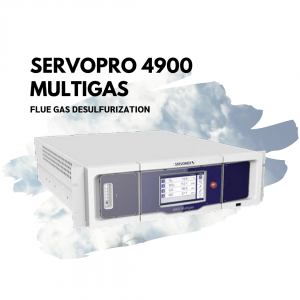
SERVOPRO 4900 Multigas
The SERVOPRO 4900 Multigas uses Infrared Gas Filter Correlation technology to measure sulfur dioxide (SO2) in this application, delivering real-time measurements accurate to very low levels, without interference from background gases.
CARBON CAPTURE AND STORAGE (CCS)
Capturing and storing carbon dioxide (CO2) that would otherwise be released into the atmosphere results in a clean air solutions environment and allows the CO2 to be used in other processes.
Once the CO2 is captured, by any method, it is then compressed into a liquid and transported for storage.
WHAT ANALYZER IS USED IN CARBON CAPTURE AND STORAGE (CCS) PROCESS
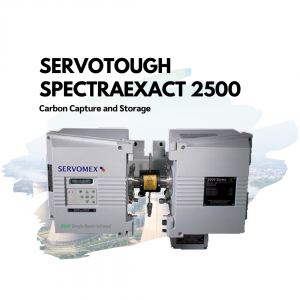
SERVOTOUGH Spectra Exact 2500
Capable of single or multi-component gas monitoring in corrosive, toxic or flammable streams, the SERVOTOUGH Spectra Exact 2500 uses Infrared and Gas Filter Correlation technologies to measure carbon dioxide (CO2) at percentage and parts-per-million levels.
EMISSIONS MONITORING [PHASE THREE]
Monitoring flue gas emissions helps determine the process efficiency and protect the environment. It also ensures – and demonstrates – that plant operators are complying with the necessary regulations.
Along with the greenhouse gases carbon dioxide (CO2), methane (CH4) and nitrous oxide (N2O), NOx and SOx are also recognized as key pollutants, as is carbon monoxide (CO). They must all be measured in order to achieve a clean air solutions strategy and meet regulatory requirements.
A continuous emissions monitoring system (CEMS) is required to measure all the necessary components of the flue gas and ensure compliance. Industries and processes requiring continuous emissions monitoring include power generation, petrochemical, refining, waste incineration, iron and steel, pulp and paper, and cement manufacture.
WHAT ANALYZER IS USED IN PHASE THREE
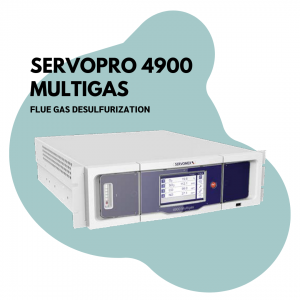
SERVOPRO 4900 Multigas
Multi-component gas analyzers are ideal for this application, and depending on the process can either deliver all the necessary measurements in one device or form a key part of an integrated CEMS. In many countries, gas analysis systems must also meet MCERTS and QAL1 certifications to comply with regulatory criteria. A single SERVOPRO 4900 Multigas can measure four gases simultaneously, but not four different gas streams, from a choice of
- oxygen (O2)
- carbon dioxide (CO2)
- carbon monoxide (CO)
- sulfur dioxide (SO2)
- nitric oxide (NO)
- methane (CH4)
- nitrous oxide (N2O)
so multiple analyzers can easily cover the pollutants of interest.
